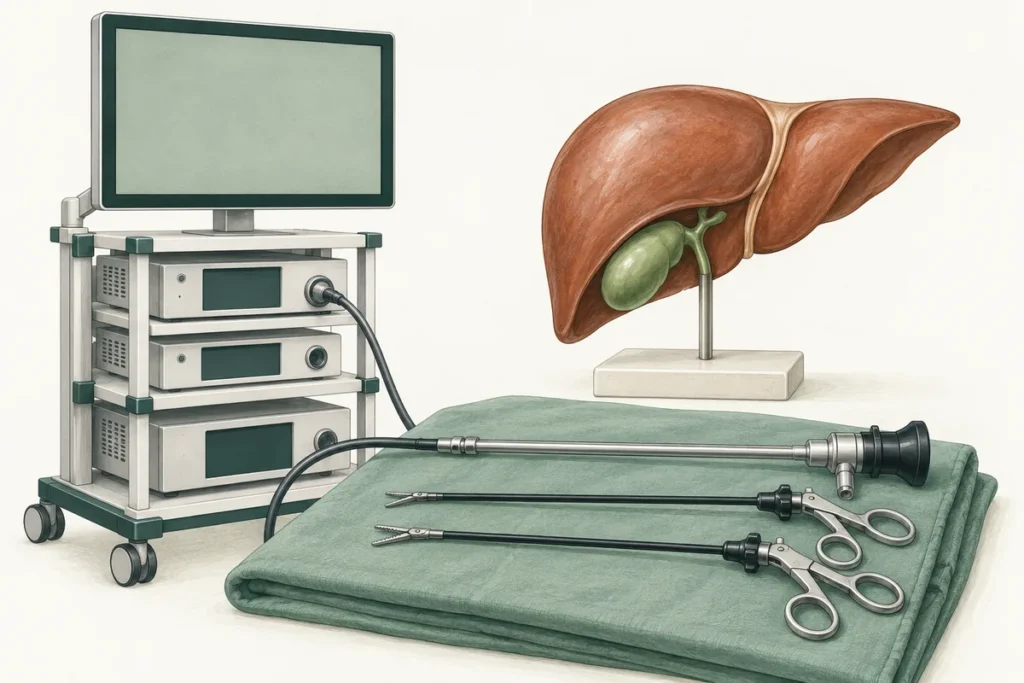
A previous caesarean section, appendix operation, bowel resection or hernia repair does not automatically rule out laparoscopic gallbladder surgery. The important details are where and why the earlier operation was performed, whether there were complications and how the anatomy may have changed. A careful history helps the surgeon plan access, anticipate difficulties and discuss realistic alternatives.
Why an earlier operation matters
Healing inside the abdomen can produce adhesions, bands of scar tissue connecting surfaces that would normally move separately. Many adhesions cause no symptoms. Their presence does not prove that every episode of pain is due to scar tissue, and not everyone with previous surgery has adhesions that interfere with gallbladder removal.
Adhesions can make entry into the abdomen or movement around organs more difficult. Separating them may take time and carry a risk of injury to bowel or other structures. Their exact extent is sometimes only apparent during the operation. The NIDDK guide to adhesions explains why the surgical history matters and why routine imaging usually cannot directly show adhesions.
Which details change the plan
An operation in the upper abdomen is more likely to be relevant to access around the gallbladder than a small lower abdominal incision, but the skin scar alone is not enough to judge. A caesarean section does not guarantee an uncomplicated laparoscopy, and a large old scar does not automatically require open surgery.
- The type, date and reason for each previous abdominal or pelvic operation.
- Whether it was open or laparoscopic and whether there was peritonitis, infection, bleeding or a return to theatre.
- Any bowel or stomach reconstruction, stoma, abdominal wall mesh or previous bile duct procedure.
- Past bowel obstruction, prolonged recovery, anaesthesia difficulties or a known postoperative hernia.
Previous stomach or intestinal reconstruction may also affect how an endoscopic bile duct procedure could be performed if one becomes necessary. Tell the team about it before investigations are arranged. Do not rely on the appearance of the scar or the name you remember if an operation report is available.
What tests can and cannot establish
Ultrasound and blood tests assess the current gallbladder problem. Additional imaging may be selected for a specific question, such as duct stones, an abdominal wall defect or altered anatomy. A CT scan is not a reliable promise that adhesions are absent. Repeating scans solely to obtain a complete “adhesion map” is not a routine solution.
The surgeon combines your records, examination and current investigations. If an earlier report cannot be obtained, describe what you know and provide the hospital and approximate date. Missing paperwork may limit planning, but should not delay urgent medical care.
How the operation may be adapted
The surgeon may choose a different first entry point or technique, adjust port positions and carefully separate adhesions needed to reach the gallbladder. Removing every adhesion is not automatically necessary. Extra dissection itself can cause harm, so the aim is safe treatment of the current problem rather than clearing all scar tissue.
Sometimes a laparoscopic operation is possible throughout. In other cases, restricted access, dense adhesions, inflammation or unclear anatomy may require a different strategy, including conversion to an open operation. The SAGES patient guide describes previous scar tissue as one reason the approach may change. A decision to change access should be discussed as a safety option, not presented in advance as inevitable or impossible.
Consent should cover foreseeable changes, including what happens if the gallbladder cannot safely be removed in the usual way. Ask whether the team may use a subtotal approach or stop and arrange specialist treatment if anatomy is unsafe. The appropriate backup plan depends on the operative findings and available expertise.
Preparation and recovery
Bring previous discharge summaries and operation reports, particularly documents describing mesh or reconstructed anatomy. Provide your current medicines and allergies. Agree medication changes with the surgical and anaesthesia teams rather than following instructions from your earlier operation, which may no longer apply.
Ask whether the earlier surgery is likely to affect the admission, assistance at home or return to physical work. Recovery depends on what is actually done and whether complications occur; a history of surgery alone does not establish a fixed recovery period. A simultaneous hernia repair or other additional procedure also needs a separate discussion rather than being assumed.
Symptoms that should not wait for planned surgery
Seek urgent assessment for severe persistent abdominal pain, repeated vomiting, marked swelling or inability to pass gas or stool. These symptoms can indicate bowel obstruction and should not be dismissed as familiar adhesions. Fever, jaundice or worsening upper abdominal pain can indicate a gallbladder or bile duct complication. Do not wait for old records before seeking help.
Frequently asked questions
Does a caesarean section mean I need open surgery?
No. The decision depends on the whole surgical history, current findings and safe access.
Can ultrasound prove that there are no adhesions?
No. A routine normal scan cannot exclude adhesions or predict every technical difficulty.
Should adhesions be removed even if they cause no problem?
Not automatically. The surgeon balances the need for access against the risks of additional dissection.
How long must I wait after my last operation?
There is no universal interval. Healing, the earlier procedure and the urgency of gallbladder treatment all matter.
Read the main guide to laparoscopic gallbladder removal. Use the contact page for a planned consultation with your records. An individual assessment is needed before deciding the operative approach.