Severe pain and deterioration should not wait
Persistent or worsening pain in the upper right abdomen, particularly with fever, shaking chills or repeated vomiting, needs urgent assessment. If pain is severe, spreads across the abdomen, or occurs with fainting, confusion, difficulty breathing or rapid deterioration, call emergency services. Do not drive yourself when seriously unwell.
You do not need to develop jaundice or every listed symptom before seeking help. It is not possible to establish safely at home whether inflammation has become complicated. An online appointment, a diet change or taking leftover antibiotics is not a substitute for emergency assessment. NHS guidance stresses timely hospital treatment for acute cholecystitis.
What these diagnoses mean
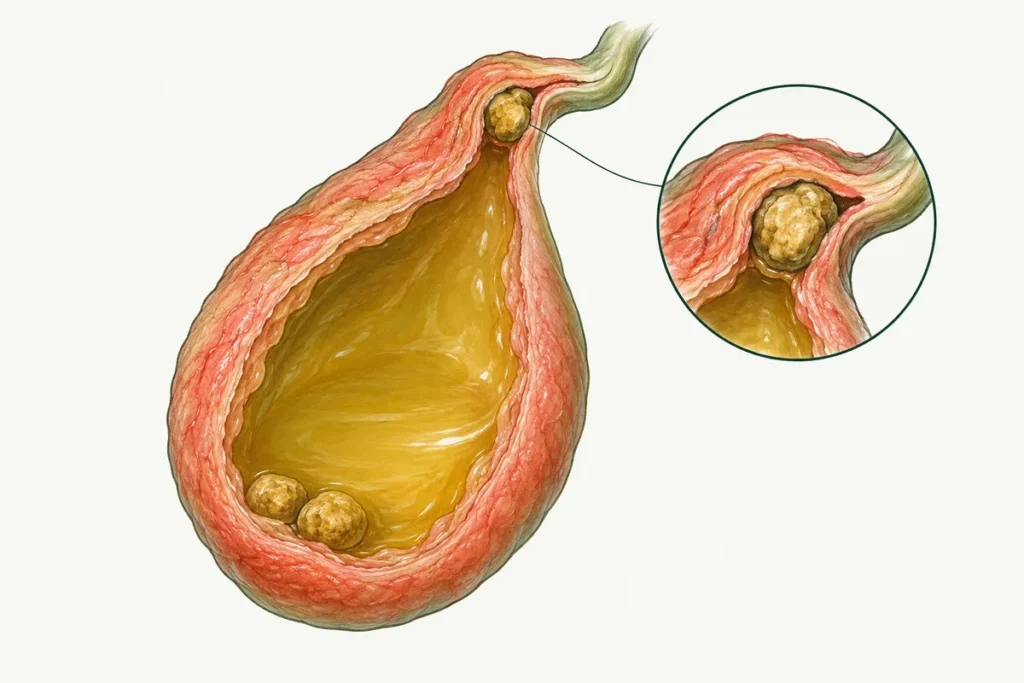
Acute cholecystitis is inflammation of the gallbladder wall. It often begins when a stone blocks the cystic duct, the gallbladder’s outlet. Rising pressure, impaired blood supply and infection can produce more extensive damage. Not every episode develops these complications, but symptoms alone cannot reliably predict the course.
- Gangrene means that part of the gallbladder wall has died because of severe injury and inadequate blood supply.
- Empyema means pus has collected inside the gallbladder. It describes infected contents, not a special type of stone.
- Perforation means a hole has formed in the wall, allowing bile and infected material to escape.
These problems can occur together. Leakage may be contained by surrounding tissue and form an abscess, or spread through the abdominal cavity and cause peritonitis. Infection can also lead to sepsis, in which the body’s response damages its organs. This explains the need for prompt care; it does not establish an identical outcome for every patient.
Why symptoms cannot identify the exact complication
The location of pain or the temperature cannot distinguish uncomplicated inflammation from gangrene or a small perforation. Severe pain can occur without these complications. Older people and those with other illnesses may have less typical symptoms. A lack of high fever does not make it safe to remain at home when overall health is deteriorating.
The hospital team checks blood pressure, pulse, breathing, awareness and the abdomen. Blood tests help assess inflammation, dehydration and organ function. Ultrasound is commonly the initial scan. CT or another investigation may be needed to clarify complications or a different cause of pain. Not every abnormality is immediately visible, and the full extent of damage sometimes becomes clear during surgery.
WSES guidance on acute calculous cholecystitis supports combining the history, examination, laboratory results and imaging. A single result or an attempt to reproduce pain by pressing on the abdomen at home cannot replace this assessment.
What happens in hospital
Initial treatment supports the patient’s condition with appropriate fluids, pain relief, organ monitoring and treatment of infection. Antibiotics are chosen according to illness severity and the clinical circumstances. They are important, but cannot by themselves close a perforation or remove dead tissue.
The central aim is to control the source of infection. Urgent gallbladder removal is often required, sometimes with drainage of an infected collection. Keyhole surgery is possible in many circumstances, but the surgeon may need to change the approach or extent of surgery when anatomy is unsafe. Conversion to open surgery or subtotal removal can be deliberate safety decisions.
If a patient is currently unsuitable for an operation, the team may consider gallbladder drainage and other measures. Age alone does not decide this choice. Circulation, other illnesses, the ability to control infection and procedural risks all matter. Following stabilisation, the team reviews whether further surgical treatment is appropriate.
Practical steps for patients and relatives
- Explain when pain started and how fever, vomiting and alertness have changed.
- Provide a list of medicines, allergies, previous operations and important medical conditions.
- Bring existing discharge summaries and ultrasound results if doing so will not delay emergency care.
- Do not try gallbladder flushes, enemas or remedies to stimulate bile flow. Follow the emergency team’s instructions about food, drink and medicines.
Before discharge, ask for a clear plan covering wound or drain care, prescribed medicines, the review date and reasons to return urgently. New fever, increasing pain, vomiting or jaundice needs reassessment rather than waiting for a scheduled check. The main article on acute cholecystitis provides background after urgent needs have been addressed.
Frequently asked questions
Can perforation occur without a previous diagnosis of gallstones?
Yes. Not having a previous diagnosis does not exclude an acute gallbladder problem. Dangerous symptoms require assessment regardless of earlier investigations.
Does temporary pain relief mean the danger has passed?
Not necessarily. A short improvement does not establish recovery if fever, weakness or other concerning symptoms remain.
Is a large open operation always necessary?
No. The surgeon chooses the approach and extent according to the patient’s condition and operative findings, prioritising safety.
Can empyema be treated with antibiotics at home?
Self-treatment at home is unsafe. Hospital assessment is needed to determine how the source of infection should be controlled.
This article provides general information and does not replace assessment and individual advice from a clinician.