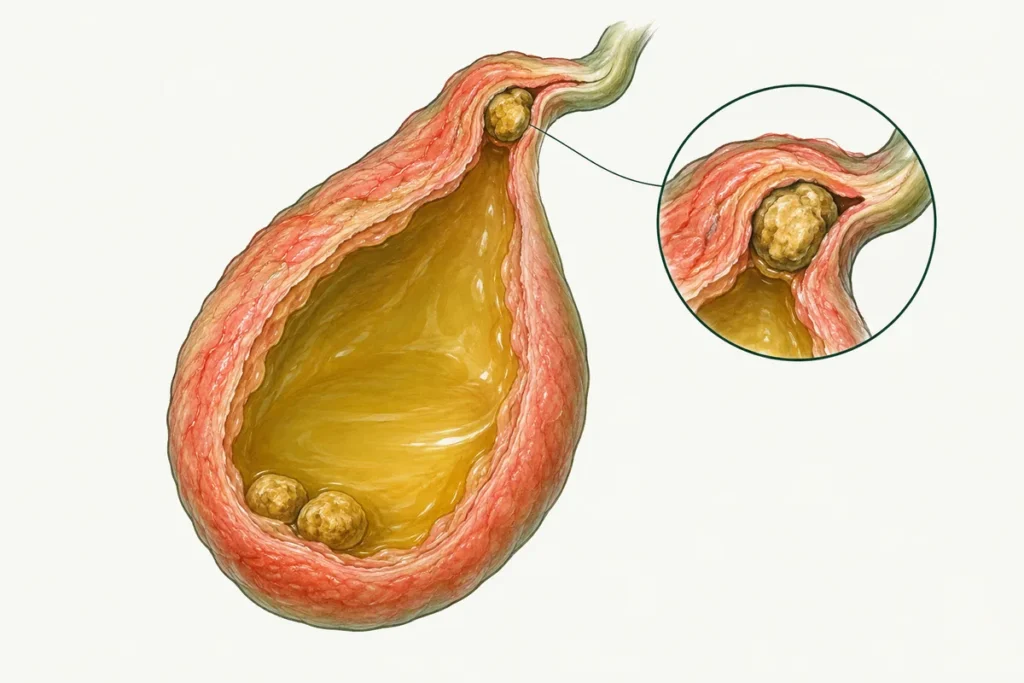
Acute cholecystitis is sudden inflammation of the gallbladder. Symptoms usually develop quickly, although they may be less noticeable in older or critically ill people. Seeking timely care allows treatment to begin and helps reduce the risk of complications. The cause of inflammation, its severity and future risks related to stones or other gallbladder changes are assessed individually. The clinician uses the investigation findings to explain the treatment and follow-up plan.
About the condition
In ICD-10, acute cholecystitis without specified stones is coded K81.0; the relevant gallstone-disease codes apply when stones are present. It is a common reason for emergency surgical care. Most cases involve a stone blocking the cystic duct.
Delayed care can allow bile stasis, pressure within the gallbladder and inflammation to worsen, while blood supply deteriorates. This increases the risk of complications. Pain intensity does not always reflect disease severity accurately.
Causes
The most common cause is a stone blocking the cystic duct, impairing bile drainage and triggering inflammation.
Increased pressure, mucosal injury and inflammatory mediators can sustain the process. The mechanism depends on the clinical situation.
A smaller proportion of cases are acalculous, without stones. This is especially important to consider in critically ill patients.
Possible associated conditions and mechanisms assessed individually include:
- injury from abnormal reflux of pancreatic contents in selected situations;
- coexisting liver disease;
- impaired blood supply, including ischemia, thrombosis or embolism of relevant vessels;
- parasitic disease, including opisthorchiasis when the exposure history is relevant;
- major trauma; congenital variations or folds need separate assessment because they are not always the cause;
- certain infections, including typhoid fever; dysentery or another intestinal infection does not prove gallbladder involvement without investigation;
- prolonged fasting, especially during serious illness;
- dehydration and impaired circulation;
- diabetes as an important associated factor rather than a single direct cause.
Acalculous cholecystitis is particularly important to consider after major surgery, during critical illness or with immunodeficiency. Rapid weight loss and restrictive diets can increase gallstone risk. Irregular meals and inactivity are assessed in the wider context. Women over 50 may have an increased risk of stones, but the disease is not limited to this group.
Classification
A descriptive classification based on the main mechanism includes:
- obstructive disease, related to a stone blocking a duct;
- enzymatic disease, related to abnormal pancreatic enzyme exposure in certain clinical situations;
- vascular disease, related to impaired gallbladder blood supply.
Cholecystitis is classified as calculous or acalculous according to whether stones are present. Parasitic involvement, such as opisthorchiasis, is identified as a cause. Severity is graded as mild, moderate or severe using clinical criteria, including organ dysfunction.
Clinical and morphological descriptions include:
- Catarrhal cholecystitis. In this form, inflammation affects the more superficial layers of the wall. Right upper abdominal pain and moderate symptoms may occur. The clinician decides where care should take place after assessing the patient’s overall condition; the name of the form cannot substitute for that assessment.
- Phlegmonous inflammation. Deeper layers of the wall become involved; stronger pain, nausea, vomiting, fever and a rapid pulse may occur.
- Gangrenous cholecystitis. Reduced blood supply can cause areas of tissue to die. Infection may add to the damage. The pace and sequence of changes vary, so severity is assessed from the patient’s condition and investigation findings rather than an assumed progression through identical stages.
- Destructive cholecystitis. This term describes damage to the wall, including necrosis and possible perforation, and partly overlaps with gangrenous disease.
Earlier appropriate care improves the chance of avoiding serious consequences. Gangrene and perforation carry a higher risk of complications, including after surgery.
Complications
Risk increases with delayed treatment, serious coexisting disease, immunodeficiency and older age. Self-treatment may postpone a necessary intervention.
Possible complications and associated conditions should be distinguished:
- scarring and contraction of the gallbladder during chronic disease;
- gallbladder hydrops from prolonged impaired drainage;
- recurrent or chronic inflammation;
- gallbladder and bile duct stones, which are often a cause or associated condition rather than a new consequence of every acute attack;
- jaundice, particularly with common bile duct obstruction;
- cholangitis, an infection of the bile ducts;
- liver injury; secondary chronic changes, including biliary cirrhosis, may occur with prolonged obstruction rather than as a typical rapid consequence of one attack;
- biliary pancreatitis;
- reactive nearby lymph nodes, sometimes lymphadenitis;
- gangrene, perforation and biliary fistulas;
- peritonitis;
- sepsis and septic shock;
- death in severe complicated cases.
Impaired bile drainage can affect the function of other digestive organs. Investigation establishes the extent of those changes. If vascular disease is involved, the clinician also considers circulation in other areas. The vessels supplying the liver, kidneys, bowel and legs are assessed when indicated: a clot affecting the gallbladder does not itself show that these other vessels are blocked.
Complications can be dangerous, so suspected acute cholecystitis needs urgent professional care. Analgesia can be part of treatment but must not replace investigation or delay seeking help.
Symptoms
The main symptom is pain in the right upper or upper central abdomen. In acute cholecystitis it is usually persistent, often lasting longer than five or six hours rather than being limited to that period. Pain may spread to the right shoulder blade, shoulder or back and worsen with breathing, coughing, food or movement. Left-sided chest pain is atypical and requires consideration of other causes, including heart disease.
Other possible features include:
- nausea and vomiting;
- abdominal bloating; protective muscle guarding is assessed separately during examination;
- chills;
- fever;
- a rapid pulse, sometimes 90-120 beats per minute or more depending on the condition;
- shortness of breath, which needs careful assessment;
- weakness and lethargy.
With appropriate care, the first signs of improvement sometimes appear within two or three days. Further recovery depends on the severity of inflammation, complications, other health conditions and the treatment chosen. The expected recovery period is therefore discussed individually and reviewed as the condition changes, rather than applying a one-week timetable to every patient.
Diagnosing acute cholecystitis
Assessment starts with symptoms and general condition. A clinician may check Murphy sign: pressure under the right ribs causes pain to intensify and a deep breath to stop involuntarily. Muscle guarding may accompany inflammation, but no single sign confirms the diagnosis.
Examination is usually followed by laboratory tests and imaging.
A complete blood count can show evidence of inflammation, although a normal result does not always exclude it.
Possible blood-test changes include:
- an increased white blood cell count;
- a raised erythrocyte sedimentation rate, a nonspecific inflammatory marker.
C-reactive protein may rise with inflammation. Bilirubin, creatinine, liver enzymes and amylase or lipase may also be checked when relevant. Bilirubin and enzymes are not necessarily raised in every case. Marked changes may indicate duct obstruction, pancreatitis or another condition.
If ultrasound and blood tests are inconclusive, or complications are suspected, CT, MRI/MR cholangiopancreatography or other tests may be required. Ultrasound is the initial imaging examination in many cases.
Treating acute cholecystitis
Treatment aims to relieve pain, reduce inflammation and address its cause. If the cause remains, further attacks and complications may occur. The likelihood of a longer-term or chronic course varies, so the clinician assesses the response to treatment and the need for follow-up for each patient.
With stones and acute cholecystitis, cholecystectomy, removal of the whole gallbladder, is often indicated. Stones cannot recur inside a removed gallbladder, but retained or new bile duct stones remain possible.
Laparoscopic surgery is performed through several small incisions. It generally causes less tissue injury and allows faster recovery than an open operation. Bleeding and other complications remain possible, however. At a consultation, the surgeon can explain whether this approach suits the individual patient; availability of the procedure should also be confirmed with the clinic.
Initial treatment may involve intravenous fluids, pain relief and antibiotics when indicated. The care team will explain whether food and drink need to be restricted temporarily; fasting should not be started independently. NSAIDs, other analgesics and sometimes antispasmodics are chosen with contraindications and risks in mind. Applying ice can injure the skin and does not replace medical care. The need for early surgery is assessed even when inflammation is described as catarrhal.
Clinical recommendations
After medical or surgical treatment, follow individualized advice. Food is reintroduced according to tolerance; a permanent restrictive diet is not necessary for everyone. Increase activity gradually and agree the timing of heavy lifting or strenuous exercise with the surgeon.
The plan depends on other conditions and recovery progress. At a follow-up appointment, the clinician can explain how to reduce recurrent symptoms, eat well and return to usual activities.
Treating gallbladder inflammation at home
Do not attempt to treat suspected acute cholecystitis yourself at home. Even temporary relief does not exclude obstruction, infection or complications. Urgent medical assessment, often in hospital, is needed.
The care team assesses your condition, arranges appropriate investigations and checks for complications. Emergency treatment may begin alongside testing rather than waiting for every result. The plan should address both the cause and consequences of the illness.
What to consider when choosing a clinic
When choosing a clinic, consider access to timely examination, the necessary tests and surgical care, together with the team’s experience. At a consultation, ask how the diagnosis will be clarified, what outcomes are expected from treatment and which risks remain in your case. Acute warning symptoms require emergency assessment without waiting for a routine appointment.
Treatment is selected according to the patient’s condition and clinical guidance. Where early cholecystectomy is indicated, carrying it out at the appropriate time takes priority over attempts to preserve the gallbladder. If surgery is currently unsuitable, other options, including drainage, may be considered. Laparoscopy is often preferred, although an open operation is sometimes safer. The reasoning behind the chosen approach and consultation arrangements can be discussed at +380953566412.
Questions and answers
The cause must first be established: impaired drainage, stones, inflammation or another condition. Polyps are often painless. See a clinician and have the recommended investigations.
Seek medical advice to establish the cause of the pain. Severe persistent pain, fever, jaundice or repeated vomiting requires emergency assessment. Appropriate pain relief can improve comfort and can be given alongside investigation; the clinician still needs to identify and treat the underlying source of the symptoms.
Acute cholecystitis may begin with aching or severe pain beneath the right ribs that does not settle. Symptoms sometimes follow fatty or fried food or a large meal. Other people notice no clear trigger, so a link with spicy food, alcohol or physical exertion is not required for an attack to be recognized.
Suspected acute cholecystitis requires urgent clinical assessment. The clinician will decide whether admission is needed and which parts of treatment or recovery can safely take place at home.
Care includes medicines and, when indicated, surgery. Early cholecystectomy is often recommended for acute calculous cholecystitis. The choice depends on investigation findings and overall health.
The cause of pain needs investigation and suitable pain relief. Analgesics can provide temporary comfort and can be used during diagnostic assessment, but their effect should not postpone examination. Seek emergency care for severe pain or other warning symptoms, even if a medicine has made you feel somewhat better.
Related reading: A cholecystitis attack · Medicines for cholecystitis · Diet for cholecystitis.