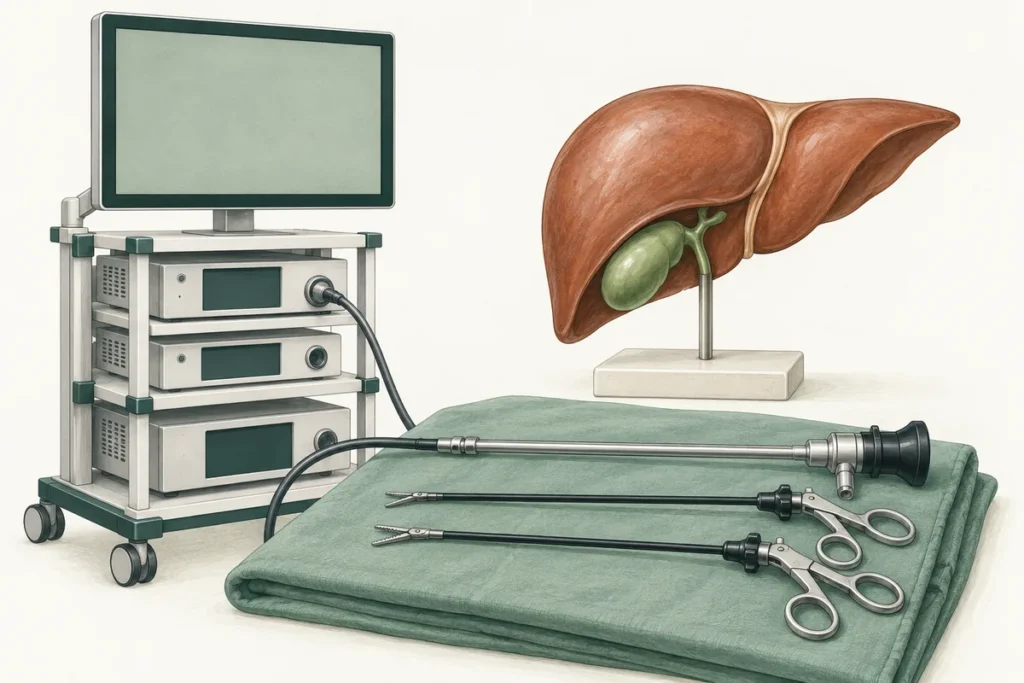
Subtotal cholecystectomy means that the surgeon removes part of the gallbladder and its accessible stones while leaving some gallbladder tissue in place. It may be performed through keyhole incisions or an open incision. It is usually considered when completing the usual dissection would create an unacceptable risk to nearby bile ducts, blood vessels or other organs.
Hearing that part of an organ remains can be unsettling. The important question is why the surgeon chose that approach in your particular operation and what follow-up it requires. The term alone does not establish that a mistake occurred or that another operation is inevitable.
Why complete removal may be unsafe
Severe inflammation and dense scarring can pull structures together and obscure their boundaries. The duct leading out of the gallbladder may be difficult to distinguish safely from the main duct carrying bile from the liver. Continuing dissection in this situation may cause harm.
Surgeons use an anatomical safety assessment before dividing structures. When this cannot be achieved and the anatomy remains uncertain, the multi-society safe cholecystectomy guideline identifies subtotal removal as a possible safety strategy. The decision depends on operative findings and surgical judgment, not simply the size or number of stones.
Changing to an open operation is another possible step, but a larger incision does not necessarily remove the problem of distorted anatomy. A subtotal procedure may still be needed after conversion. These are different decisions: one concerns the route of access, the other how much gallbladder tissue is removed.
What different types mean
The operation report may describe a reconstituting or fenestrating subtotal cholecystectomy. In the reconstituting approach, the remaining gallbladder is closed to form a small remnant. In the fenestrating approach, a closed remnant is not created; the opening of the cystic duct may be closed from inside when possible.
These approaches have different trade-offs. Leakage can be an important early concern, particularly when the remnant cannot be closed. A closed remnant may later develop stones or recurrent inflammation. Neither approach eliminates all complications, and the inflamed tissue may limit what is technically possible.
You do not need to interpret the surgical terminology alone. Ask the surgeon to explain what was left, whether it was closed, whether stones remained and whether a drain was placed. Keep the written operation report for future consultations.
Early recovery and drains
A drain may be left near the operation site to remove and monitor fluid. If you go home with one, you need written instructions on its care, any output recording, dressing changes, the next review and whom to contact outside routine hours. Do not clamp, flush or remove the drain unless specifically instructed by the treating team.
Bile in a drain can occur after subtotal surgery, but it should not be dismissed as harmless. The team judges the amount, its trend, your symptoms and test results. Some leaks settle with controlled drainage and observation; others need ERCP with a temporary stent, image-guided drainage or another intervention.
Recovery may take longer than after an uncomplicated complete keyhole removal because the original inflammation was more severe or additional treatment is needed. Activity, work and diet advice should therefore follow your discharge plan rather than a fixed online timetable. Ask when the removed tissue’s pathology result will be reviewed.
Symptoms that need urgent attention
Contact the surgical team promptly for increasing or persistent abdominal pain, fever or chills, repeated vomiting, progressive abdominal swelling, jaundice, redness or pus at a wound, or an unexpected change in drainage. Sudden loss of drainage together with pain or fever also deserves assessment.
Severe symptoms with fainting, confusion, difficulty breathing or rapid deterioration require emergency care. Do not wait for the routine follow-up appointment. A photograph or a drain-volume record can help the clinician, but should not delay seeking help.
Does the remaining tissue need to be removed later?
Not automatically. Some people have no further gallbladder-related problems. Others develop symptoms from stones in the remnant or bile ducts, recurrent inflammation or another condition unrelated to the remnant. New pain should be investigated rather than attributed to the remaining tissue without evidence.
Depending on symptoms, assessment may involve blood tests, ultrasound or MRCP. ERCP may be appropriate for a duct problem. A completion cholecystectomy is considered only for selected patients after careful review; scarring can make repeat surgery complex, so relevant expertise matters.
Questions before leaving hospital
- Why was subtotal removal chosen, and which type was performed?
- Are there known remaining stones or concerns about the main bile ducts?
- Who will review my drain, any stent and the pathology result?
- When is follow-up, and which changes should prompt earlier assessment?
For the general operation, see the guide to laparoscopic cholecystectomy. You can use the contact page to arrange a planned discussion of the operation report. Urgent symptoms need a direct medical assessment.
Frequently asked questions
Does subtotal surgery mean the procedure failed?
Not necessarily. It can be an intentional response to dangerous anatomy. The reasons and subsequent course should be explained individually.
Will the gallbladder grow back?
It does not normally regrow as the original organ. Remaining tissue can persist and, in some cases, contain or develop stones.
Is a second operation always planned?
No. Further surgery depends on symptoms, findings and the balance of expected benefit and risk.
Can a special diet prevent every future problem?
No. Follow individualized dietary advice, but do not rely on a diet or supplement to remove retained stones or prevent a postoperative leak.