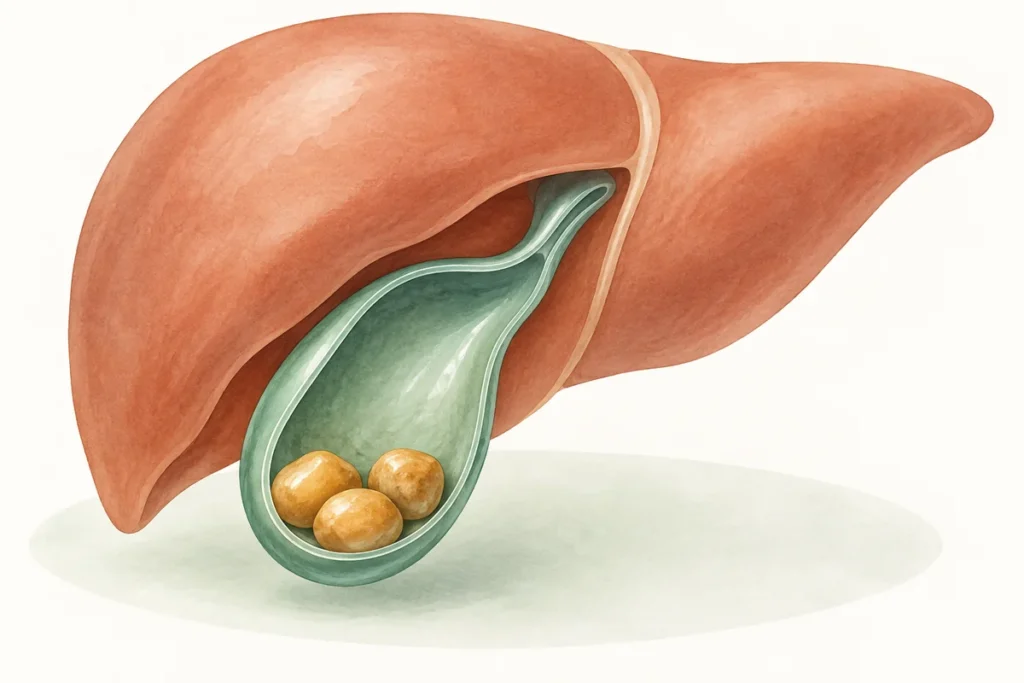
If gallstones were found incidentally during an ultrasound scan and you have not had typical attacks or complications, surgery is not always necessary. Observation is usually the preferred approach for gallstones that cause no symptoms when the gallbladder has no other abnormal changes and the bile ducts are normal. The first step after receiving this result is to check with your doctor that your findings really fit this situation.
This article will help you prepare for a consultation and understand which circumstances can change the decision. It does not cover an acute attack, jaundice or already confirmed stones in the common bile duct.
What “asymptomatic gallstones” means
Having no pain today does not necessarily mean your gallstones are asymptomatic. Your doctor will ask whether you have previously had attacks of pain in the upper abdomen or under the ribs on the right, needed emergency care, or had gallbladder inflammation, pancreatitis or jaundice. Your symptoms over the past year are particularly important, and you should report any previous complications, however long ago they occurred.
Gallstones found by chance during an ultrasound scan for another reason and gallstones found after several typical attacks need different discussions. The phrase “they are not bothering me now” can describe either situation. If you have already received treatment for gallstones, bring your previous discharge summary.
Is every digestive symptom caused by gallstones?
A bitter taste in the mouth, heartburn, belching or bloating does not by itself prove that the gallbladder is the cause. Typical biliary pain is usually much more pronounced: it occurs in the upper abdomen or under the ribs on the right, lasts more than 30 minutes and may be accompanied by nausea. However, a description on a website cannot establish the cause of your pain.
It is more helpful to describe a specific episode to your doctor than to call it a “liver attack”: where it hurt, how long it lasted, whether it interfered with movement or sleep, and whether you had a fever, vomiting or a change in urine colour. This helps assess whether your symptoms are related to gallstones and avoids expecting surgery to resolve symptoms that have another cause.
What to clarify in your ultrasound report
The size of the largest stone is not the only important finding. Your doctor will assess the whole report: the condition of the gallbladder wall, possible signs of inflammation, the width of the bile ducts, other findings and how clearly the structures could be seen. If the report mentions a polyp, a mass or unusual changes in the wall, these need a separate assessment. The general approach of observing asymptomatic gallstones does not settle the question of another condition.
Bring the full scan report, rather than just a note saying “gallstones present”. If possible, include the images and previous results. For information on preparing for the scan and what it can show, read the article about gallbladder ultrasound.
A stone in the gallbladder and a stone in a bile duct need different approaches
The common bile duct carries bile to the intestine. Stones in this duct can block the flow of bile and cause complications even after a period without symptoms. The recommendation to “observe while there are no symptoms” therefore does not automatically apply to confirmed common bile duct stones, also called choledocholithiasis.
ESGE recommends removing confirmed common bile duct stones in patients who are well enough to undergo the procedure, including those without symptoms. The specific method and the balance of benefits and risks are determined individually. Read more about this situation in the article “Choledocholithiasis”.
When observation is a reasonable choice
NICE guidance supports observation when gallstones cause no symptoms, the gallbladder has no other abnormal changes and the bile ducts are normal. EASL guidance takes a similar approach. This avoids an operation whose benefits for that person do not currently outweigh its risks.
Observation should include a clear plan: which symptoms to watch for, when to arrange another appointment and where to seek help if acute pain develops. Worries about the word “stone” itself are worth discussing with your doctor, just as worries about surgery are. The aim of the consultation is to help you understand the reasons behind the decision, rather than leave you to deal with uncertainty on your own.
- Ask whether your situation meets the criteria for asymptomatic gallstones.
- Clarify whether other ultrasound findings or the cause of your symptoms need investigation.
- Agree on which changes in your condition would mean the treatment plan needs to be reviewed.
- Ask whether you personally need another ultrasound scan and what clinical question it would answer.
Do not arrange the same annual set of blood tests and scans for yourself solely because you have gallstones. The frequency of follow-up depends on the specific findings and changes in your condition. If new symptoms appear, do not wait until the date of a scheduled examination.
When the decision about surgery is reconsidered
Repeated typical attacks or previous complications change the assessment of the benefits of cholecystectomy, the operation to remove the gallbladder. Suspicious gallbladder changes found during an examination also need particular attention. However, the size or number of stones alone, without the rest of the information, cannot justify a universal recommendation for everyone to have surgery.
The discussion also takes account of your overall health: the risks of anaesthesia, other medical conditions, previous procedures, access to medical help and your priorities. Ask what specific reason leads your doctor to recommend surgery now and what would change if you chose observation. If the explanation is unclear, a second consultation with your full set of medical records may help you make an informed decision.
What you can do before your next consultation
Keep your test results and make brief notes of any new episodes of pain. Discuss your diet in light of the foods you tolerate and any other medical conditions. There is no need to start a strict diet solely because of an incidental finding or to assume that a diet is guaranteed to get rid of existing stones.
Do not use “gallbladder flushes” or medicines that stimulate bile flow to try to remove stones yourself. Drug treatment has specific, limited indications; it is not automatically prescribed for everyone with an asymptomatic finding. General information about the condition is available in the article “Gallstones”.
Symptoms that should not wait
New pain in the upper abdomen lasting more than 30 minutes needs prompt medical assessment, even if your gallstones were previously considered asymptomatic. Seek emergency medical care for sudden severe or worsening pain, fever or chills, jaundice, or pain spreading to the back with vomiting. Do not try to wait out an attack until a routine appointment.
To discuss an incidental finding and the options for observation or surgical treatment without the pressure of an acute episode, you can book a consultation by calling +38 (095) 356-64-12. Bring your ultrasound report and describe any previous attacks, even if they resolved on their own.
Sources
- NICE CG188: diagnosis and management of gallstone disease.
- EASL: clinical practice guidelines on gallstone disease.
- ESGE: management of common bile duct stones.
- NHS: gallstone symptoms and when to seek help.
This article is for information only and does not replace an individual assessment of your symptoms and test results.