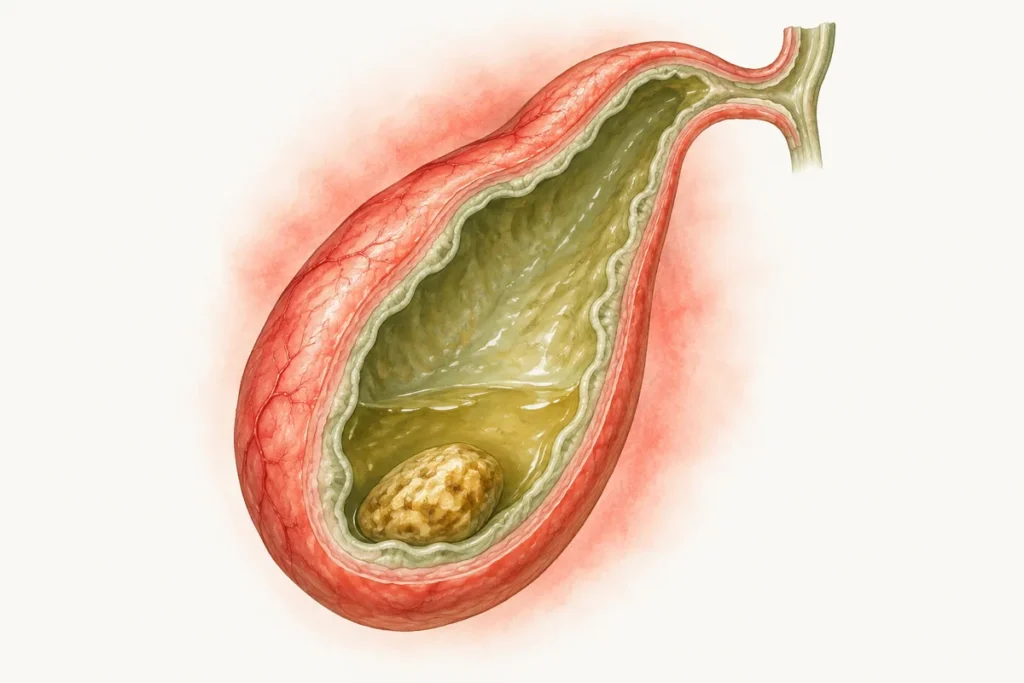
Gallbladder inflammation is often associated with gallstones, which are more common in women and older adults. Cholecystitis may coexist with stomach, pancreatic or liver disease, although each can also occur separately. This article explains which symptoms need attention and how treatment is chosen. The cause of inflammation, its severity and the investigation findings guide the plan and help the clinician discuss what to expect during recovery.
What is cholecystitis?
Cholecystitis is acute or chronic inflammation of the gallbladder wall. This hollow organ stores bile made by the liver. Bile works alongside pancreatic enzymes to help digest and absorb fats.
Inflammation most often begins when a stone obstructs the cystic duct. Bacterial infection may follow. Viral, fungal and parasitic involvement is much less common and requires separate confirmation. Inflammation causes swelling and accumulation of immune cells in the wall. Acalculous inflammation can occur, particularly during severe illness or impaired blood supply. Allergic, autoimmune or toxic causes should not be assumed without investigation. Impaired drainage and changes in bile composition may contribute to stones and infectious complications.
Why can cholecystitis symptoms recur?
When assessing recurrent symptoms, a clinician considers possible triggers and associated conditions:
- Large meals and fatty or fried dishes may trigger pain in some people. Alcohol can worsen other digestive conditions. Food tolerance varies and does not by itself establish a diagnosis.
- Metabolic factors and bile composition may contribute to stone formation. Gallstones and cholecystitis are often linked: a stone may block a duct and cause inflammation, but not every stone produces a painful attack.
- Family predisposition: gallstones occur more often in some families.
- Assessment takes account of changes in gallbladder and duct motility during pregnancy, as well as obesity and limited physical activity. Nerve and hormonal regulation, eating patterns and stress also influence digestion. These details help build the overall picture, while the cause of acute inflammation is established through examination and appropriate investigations.
- Anatomical variations, including folds or constrictions. These are often incidental findings; their effect on drainage must be assessed individually.
- Dental disorders can make eating more difficult, while stomach, pancreatic and liver disease may cause similar symptoms and affect nutrition. A direct causal link between inadequate chewing and cholecystitis has not been established. If a liver condition or a disorder of a neighboring structure affects the biliary system, investigation helps clarify the mechanism and its importance for treatment.
- Parasitic infections are considered in light of possible exposure. Ascaris and some liver flukes, including those causing opisthorchiasis, can affect the bile ducts. Amoebiasis primarily involves the bowel or liver. If giardiasis is found, the clinician assesses its relationship to the symptoms separately. Treatment requires confirmation of the particular infection and an understanding of its role in the current illness.
Feeling worse sometimes coincides with stress, poor sleep or a cold. These circumstances are worth discussing with the clinician, but new symptoms still need investigation of their specific cause. An assumption that the immune response has weakened or an infection has become more active is not enough to choose the appropriate treatment.
Chronic inflammation can cause fibrosis and distortion of the gallbladder. Periods with few symptoms may alternate with recurrent episodes, although the course varies between people.
Symptoms of gallbladder inflammation
Possible features of an exacerbation or acute inflammation include:
- Pain beneath the right ribs may feel aching, sharp or heavy. It can spread to the upper central abdomen, right shoulder blade, shoulder or collarbone; spread to the neck is less typical. Some people notice symptoms one to three hours after food, particularly a large meal. Timing can vary, however, so the clinician considers it together with other features rather than using it alone to establish the diagnosis.
- A raised temperature, sometimes mild and sometimes above 37.5°C, weakness, nausea or headache. Absence of fever does not rule out serious illness.
- Nausea and vomiting, sometimes containing bile, which gives a greenish color and bitter taste. Belching, bloating, diarrhea or constipation can occur. A bitter or metallic taste is nonspecific and does not establish cholecystitis on its own.
Stones may cause recurrent biliary colic. A common bile duct stone can cause obstructive jaundice: bilirubin accumulation turns the skin and eyes yellow, urine darkens, stools become pale and itching may occur. Dry skin is nonspecific. These features are not typical of isolated uncomplicated cholecystitis and require urgent investigation.
The clinician takes a symptom and medical history, examines the skin, mucous membranes and abdomen, and assesses general condition, height, weight and nutrition.
During examination, a clinician may assess the signs described below. Do not try to reproduce them yourself; none establishes a diagnosis in isolation:
- Mussi-Georgievsky sign: tenderness above the collarbone between the heads of the sternocleidomastoid muscle, associated with phrenic nerve irritation.
- Kera sign: tenderness over the gallbladder’s projection beneath the right costal margin.
- Murphy sign: increased pain and interruption of a deep breath during palpation of this area.
- Grekov-Ortner sign: tenderness during gentle tapping of the right costal margin as part of a clinical examination.
Further investigations may be needed to establish the diagnosis and severity:
- Ultrasound can show stones, wall thickening, surrounding fluid, polyp-like lesions and other changes. A wall thicker than 4 mm may be suspicious but does not by itself prove inflammation. Management of stones depends on more than size or number: symptoms, complications and location matter. Even a small stone may block a duct, while uncomplicated symptom-free gallbladder stones are often observed.
- Blood tests help assess inflammation, liver function and other possible causes. Urine and stool tests are performed when indicated. Bile testing may be useful in selected circumstances; duodenal intubation is not a mandatory routine test for every patient.
- Each imaging test is chosen to answer a particular clinical question. Contrast X-ray techniques were used historically to examine the gallbladder and ducts; assessment today may involve MR cholangiopancreatography, endoscopic ultrasound or other appropriate tests. Procedures that involve introducing instruments into the body need a clear diagnostic or treatment purpose, rather than being used simply as routine checks of gallbladder “tone.”
Treating gallbladder inflammation
Medical care aims to control symptoms and treat infection when indicated. It does not always replace surgery and may include:
- Antibiotics, including selected cephalosporins or other agents appropriate to the situation. In severe illness, treatment is not delayed while waiting for a bile culture. If a sample is obtained, the results can guide adjustment.
- Pain-relieving and anti-inflammatory medicines, including NSAIDs when there are no contraindications.
- Antispasmodics, such as drotaverine (No-Spa), in selected situations.
- Festal, Allochol, magnesium preparations, sea buckthorn oil and other enzyme, herbal or bile-stimulating products have different properties and indications. After diagnosis, the clinician decides whether any is appropriate for a specific digestive problem. Stimulating bile flow when a duct is obstructed may be dangerous, so these products should not be started independently or relied on to restore digestion in every case.
During an episode, agree activity and nutrition with the clinician. Dietary changes may reduce symptoms but do not treat acute inflammation on their own. Foods that sometimes need limiting because of poor tolerance include:
- Fatty cuts of lamb, beef, duck or pork, particularly when fried or smoked. Portion size and preparation should take account of the amount of fat and your tolerance, rather than excluding a type of meat solely because of its name.
- Marinades, pickles, very spicy dishes, pepper and garlic when they trigger symptoms. Whether to limit them is decided according to individual tolerance and the agreed eating plan.
- Fizzy drinks if they increase bloating or discomfort. The reason for limiting them is how you feel after drinking them; the cause of gallbladder inflammation needs separate assessment.
Regular meals in smaller portions may be easier to tolerate. Meal frequency can be adjusted to your symptoms and usual routine; eating six times a day is one possible arrangement. Boiled, steamed, stewed or baked dishes can help you broaden the menu gradually as you return to a balanced diet.
Surgery is usually discussed for symptomatic stones and cholecystitis. Bile duct stones also require a specific management plan. A stone may cause obstruction, pressure and inflammation, but an incidental finding of gallbladder stones without symptoms or complications does not always justify removal.
For a stable patient, the surgeon may recommend an elective operation. Early surgery is often advised in acute cholecystitis: timing is based on the patient’s condition rather than waiting solely for medicines to resolve every sign of inflammation. The surgical team chooses the appropriate time after assessment.
Surgical care includes laparoscopic gallbladder removal, open surgery when necessary, and separate endoscopic procedures for duct stones. These are different interventions with different indications.
Minimally invasive approaches may offer the following advantages, depending on the individual case:
- Less tissue injury and lower risk of some complications than open access, although risks are not eliminated.
- Usually a shorter hospital stay and recovery.
- Potentially lower overall costs, although the actual price depends on the clinic and treatment complexity.
- Small incisions, usually several access sites; one may be around 2 cm, but techniques and sizes vary.
- The possibility of treating older or frail patients after individualized risk assessment.
During laparoscopy, a camera and instruments are introduced into the abdomen through small incisions. Standard cholecystectomy removes the gallbladder together with its stones. Removing only the stones or polyps while preserving the organ is not the usual alternative to this operation. When planning surgery, the surgeon assesses the reasons for removal alongside marked distortion or calcification, which can affect how the operation is performed. The decision takes all of these findings into account.
Laparoscopic cholecystectomy is normally performed under general anesthesia. Preoperative assessment may include blood counts, biochemistry, sometimes urine tests, an ECG and other investigations when indicated. A chest X-ray is not required for everyone. Allergies and medicines are reviewed; cardiology, gastroenterology, general medicine or other specialist advice is obtained when needed.
Rehabilitation is planned around the patient’s condition and the treatment already received. Diadynamic currents, UHF, electromagnetic procedures and electrophoresis with procaine, No-Spa or magnesium have no established role in standard care for stones or acute cholecystitis. These procedures should not be relied on to restore gallbladder function; a recovery program should instead be agreed with the treating team.
Shockwave fragmentation of gallbladder stones is used rarely and in selected cases. Its suitability is assessed against the risk that fragments may block a duct, so their passage cannot be assumed to be straightforward. Common bile duct stones are often removed during ERCP. An endoscope passes through the mouth and stomach into the duodenum to reach the duct opening. Unlike ordinary gastroscopy, this is a specialized treatment with its own risks, which are discussed before the procedure.
Questions and answers
Symptoms vary. There may be heaviness or pain beneath the right ribs, nausea, sometimes a bitter taste, bloating, belching or altered bowel movements. These are nonspecific. Severe persistent pain, fever, jaundice or repeated vomiting needs urgent assessment.
See a clinician to establish the cause of the symptoms. Similar complaints occur with liver disease, pancreatic disease and other conditions, less commonly including tumors. Diagnosis draws on the history, examination, blood tests and appropriate imaging. Equipment provides useful information that the clinician interprets alongside the overall clinical picture. Acute warning symptoms call for emergency care rather than a routine consultation.
The clinician decides based on severity, stage and other health conditions. They will explain which parts of care can be carried out at home, including diet, medicines and activity. Suspected acute cholecystitis or complications may require admission.
Treatment is planned individually and may combine several methods. Recovery depends on the diagnosis, disease severity, timely care and other features of the patient’s condition. Team experience and appropriate testing help guide the plan. During treatment, the clinician follows the symptoms and revises the next steps when needed; the pace of improvement varies.
Contact the Center for Laparoscopic Surgery to ask about available gastroenterology, surgery, diagnostic and rehabilitation appointments, as well as testing and treatment options.
Ask the administrator at +380953566412 about current prices and discounts for pensioners or people with disabilities. Agree treatment and stay arrangements in advance.
Related reading: Acute cholecystitis · Gallbladder ultrasound · Medicines for cholecystitis.