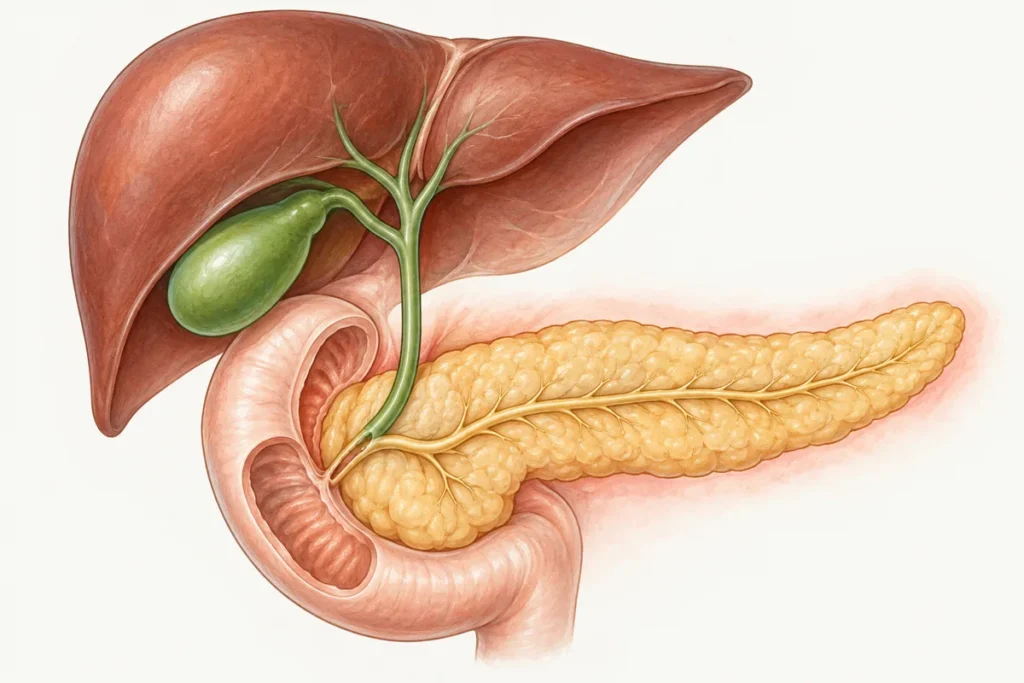
Pancreatitis and cholecystitis can impair digestion. The pancreas produces digestive enzymes, while the gallbladder stores and releases bile made by the liver. These organs work together, but their diseases do not always occur together. Timely investigation is needed to choose the right treatment.
About the conditions
Pancreatitis is inflammation of the pancreas, which produces pancreatic juice containing several enzymes. Cholecystitis is inflammation of the gallbladder wall. A stone obstructing bile drainage is a common cause of cholecystitis, although stasis is not the only possible mechanism.
Symptoms
Pancreatitis and cholecystitis can have an acute or chronic course. A stone near the outlet of the bile and pancreatic ducts can trigger pancreatitis. Pancreatic injury, swelling and inflammation develop through several mechanisms, so investigation seeks the cause in the individual case rather than attributing every episode to bile reflux with bleeding.
Complaints that may occur with pancreatitis or cholecystitis include:
- Upper abdominal pain, including the epigastrium or right upper quadrant. It may be severe, episodic or constant.
- Nausea, bloating, diarrhea and excess gas.
- Fever.
- Weakness.
- Fatigue and loss of energy.
- Dry mouth.
- A bitter taste.
- Reduced appetite and weight loss.
Symptoms can overlap when both organs are affected. Pancreatitis often causes upper central abdominal pain radiating to the back; it is not necessarily left-sided. Pain under the right ribs can suggest gallbladder disease but is insufficient for diagnosis. Dry mouth and bitterness are nonspecific. Severe persistent pain, repeated vomiting, fever or jaundice requires urgent care.
Treating cholecystitis and pancreatitis
A clinician can establish the cause and arrange investigations. A gastroenterologist may coordinate ongoing care, while acute illness can require emergency admission and surgical assessment.
The goals of care are to:
- identify the cause of organ injury;
- provide appropriate treatment;
- relieve pain and other symptoms;
- reduce the risk of complications and treat any already present.
When pancreatitis and cholecystitis occur together, the clinician checks for stones and assesses the bile ducts. Other possible contributors to pancreatic injury are considered at the same time, because a gallbladder finding may not explain every change or symptom.
The findings guide the next steps:
- Surgical treatment may include gallbladder removal when stones are responsible. The team determines timing after investigation. Surgery is often early in mild biliary pancreatitis but may be postponed in severe disease. Preparation is individualized and can involve:
- temporarily restricting food for a clear reason, such as before anesthesia or during uncontrolled vomiting;
- food of a tolerated consistency; puréeing is not compulsory for everyone;
- pain relief and other medicines when indicated; enzyme replacement is prescribed for established insufficiency, with the need assessed from the patient’s condition rather than an isolated test value.
After gallbladder removal, agree nutrition and follow-up with the clinician. Coexisting pancreatitis may require additional dietary advice and gastroenterology follow-up.
If no stones are found, investigation continues to clarify the cause of symptoms. Treatment may still be needed for severe acalculous cholecystitis or another obstruction to bile drainage. The need for intervention is judged from the patient’s condition and investigation findings, rather than the presence of stones alone.
Diet for pancreatitis and cholecystitis
Nutrition forms part of the overall treatment plan alongside the necessary medicines and procedures. Food is chosen according to tolerance, pancreatic and biliary function, and the risk of malnutrition. The aim is to provide enough energy and nutrients at every stage. Treatment of the underlying cause continues alongside dietary care, even when suitable meals have been found.
An agreed eating plan may help control symptoms. Its effect is assessed through comfort and nutritional adequacy: adding stricter restrictions does not by itself ensure faster improvement or prolonged remission. If complaints continue, the plan should be reviewed with the clinician or dietitian.
The approach to food changes with the stage and severity of illness.
In acute pancreatitis, food is restricted for specific clinical reasons, such as vomiting. A day of fasting should not be imposed independently. If ordinary eating is impossible, the team selects appropriate nutritional support. Feeding through the digestive tract is preferred when feasible, while the need for intravenous nutrition is assessed separately according to the patient’s condition.
Once a patient can eat, the choice of foods and their texture are guided by tolerance. Soups, porridge and vegetable purées may be convenient at this stage. The pace of broadening the menu is individual; everyone does not need to pass through the same sequence of liquids followed by puréed food.
The diet is gradually broadened to provide adequate protein, energy and vitamins. Fat and salt intake are tailored to the condition and other health needs. Unnecessary severe restriction can lead to nutritional deficiencies.
Smaller, more frequent meals may be easier to tolerate. Portion size and meal frequency are individualized. A dietitian can help if weight loss or pancreatic insufficiency is present.
Examples of foods that may fit a diet during a stable period include:
- Bread, rusks or lavash. Fresh or toasted bread can be chosen according to tolerance and how it fits with the rest of the diet.
- Vegetables such as beetroot, courgettes, potatoes and pumpkin.
- Fruit that is well tolerated. Watermelon can also fit the menu, taking account of portion size, symptoms and blood glucose. Its inclusion is considered in the context of the current condition rather than a fixed remission period for everyone.
- Plain yogurt, kefir, fermented baked milk and sour cream of a suitable fat content if dairy is tolerated.
- Water, tea with milk, kissel, compote and fruit or vegetable infusions. Have juice in moderation. If choosing mineral water, consider its composition; it is not an essential part of treatment.
- Different grains as porridge of a tolerated consistency.
- Lean meat and fish.
- Cooked eggs or egg whites, and steamed or baked omelets, according to tolerance.
- Vegetable soups and purées.
- Small amounts of butter or vegetable oil within the agreed fat intake.
- Sweets in moderation. Honey is also counted as added sugar, particularly with diabetes; it may be chosen for taste, but a specific therapeutic effect in these conditions should not be expected.
During a flare-up, the following foods may need to be limited. The extent and duration of changes depend on tolerance and the treatment plan:
- Rich pastries and fatty baked goods. Ordinary bread is considered separately and can remain in the diet if it is well tolerated.
- Oily fish and fish liver, including cod liver. Portions may need adjusting within the overall fat intake; other marine fish is assessed according to tolerance.
- Fatty processed meats and selected offal.
- High-fat hard cheese, depending on portion size and tolerance.
- Smoked and heavily salted foods.
- High-fat milk and fermented dairy products if they worsen symptoms.
- Large portions of chocolate, ice cream and buttercream pastries.
- Cabbage dishes if they increase gas.
- Very fatty or rich meat and mushroom broths.
- Legumes if they cause discomfort. Types and portions that are well tolerated can remain part of a varied diet.
- Manufactured sauces, marinades and pickles with substantial salt or fat.
- Hot spices, pepper and garlic if they trigger symptoms.
- Strong tea and coffee; caffeine may need limiting.
- Fizzy drinks if they increase bloating. This also applies to sparkling mineral water, which should be assessed by the same response to drinking it.
- Alcoholic and low-alcohol drinks: avoiding alcohol is recommended with pancreatitis.
- Tomatoes can be included according to tolerance. If their acidity causes discomfort, discuss a suitable portion or preparation method with the clinician to avoid excluding the food entirely when this is unnecessary.
The historical name “Diet No. 5” is sometimes used to describe a gentle eating pattern. The actual plan should reflect the diagnosis, nutritional needs and tolerance; necessary medicines are decided separately. The menu below is an example for a stable period. Adapt portions, protein and energy to your needs and the clinician’s advice. During an acute attack, the treating team provides instructions about food and drink, so the menu should not be used for self-treatment. Recovery is assessed from the overall condition.
Example seven-day menu for pancreatitis and cholecystitis
Day one
First meal: milk and vermicelli soup, tea.
Second: a soft-boiled egg prepared safely, and a chicory drink.
Third: a light soup and a slice of dried bread.
Fourth: yogurt and one pear.
Fifth: chicken pilaf, fresh cucumber and kissel.
Day two
First: an omelet and tea.
Second: baked cottage cheese pancakes.
Third: soup with croutons and boiled turkey breast.
Fourth: kefir and a sweet apple.
Fifth: mashed potatoes and boiled fish.
Sixth: cottage cheese with dried fruit.
Day three
First: oatmeal and tea.
Second: kissel, a thickened fruit drink.
Third: vegetable soup.
Fourth: cottage cheese with non-acidic berries.
Fifth: meat patties with buckwheat.
Sixth: vegetable purée.
Day four
First: an omelet and tea.
Second: cottage cheese casserole and kissel.
Third: vegetable soup.
Fourth: cheese, tea and an apple.
Fifth: stewed chicken with boiled potatoes and herbs.
Sixth: apple juice.
Day five
First: buckwheat and milk.
Second: fruit and a rosehip infusion.
Third: meat soup.
Fourth: plain yogurt and a non-acidic fruit.
Fifth: chicken breast baked with courgettes.
Sixth: sweet-berry kissel.
Day six
First: semolina porridge with a little butter and sugar, and a rosehip infusion.
Second: a soft-boiled egg prepared safely, and herbal tea.
Third: stewed vegetables and steamed meatballs.
Fourth: soft cottage cheese with a few raisins or prunes.
Fifth: meat patties with rice.
Sixth: pumpkin juice.
Day seven
First: porridge made with milk.
Second: kissel and biscuits.
Third: fish with vegetables.
Fourth: apple or pumpkin.
Fifth: pasta with low-fat cheese.
Sixth: a steamed cottage cheese cake and a glass of low-fat kefir.
The duration of restrictions is individualized and reviewed as the condition changes. Balanced eating remains useful, while the need to prevent and treat further attacks is assessed separately. In chronic pancreatitis, particular attention is paid to adequate nutrition and whether enzyme replacement is needed.
Bile-stimulating medicines for cholecystitis and pancreatitis
When bile drainage is impaired, the first step is to establish whether a stone or another cause is responsible. Its effect on the pancreas is assessed separately, as not every episode of stasis leads to pancreatitis. Bile-stimulating medicines are not standard treatment for these two conditions and cannot be relied on to reduce swelling. If duct blockage is possible, do not start them independently: investigation and treatment directed at the cause are needed first.
Trimedat for pancreatitis and cholecystitis
Trimedat contains trimebutine, which affects gastrointestinal motility. It may be prescribed for certain functional disorders. The clinician assesses whether there is such an indication and explains the expected effect on pain or gas. In pancreatic or gallbladder inflammation, treatment must address the underlying cause; Trimedat is not the main treatment and cannot be relied on to restore bile drainage or relieve every symptom.
Ursosan for cholecystitis and pancreatitis
Ursosan contains ursodeoxycholic acid. It is prescribed for particular indications, including dissolution of some cholesterol stones in patients for whom the method is suitable. The clinician assesses this option from the investigation findings and the specific diagnosis. Dissolution takes prolonged treatment, and stones may form again afterward. Acute cholecystitis or pancreatitis requires separate assessment of the care needed; a prescription for Ursosan should be based on its established indications.
Five movements during recovery
During a stable period, these movements may form part of a recovery program agreed with a clinician or physiotherapist. They do not replace treatment for pancreatitis or cholecystitis. Seek medical clearance first if there is acute pain, fever, vomiting or recent surgery. Use a firm, stable surface and a pillow if needed. Stop if pain, nausea or dizziness occurs. The repetition counts are guides; an appropriate level of activity is chosen individually.
Exercise 1
Lying on your back with arms at your sides, slowly bring your bent legs towards your abdomen within a comfortable range, then return. If cleared by your professional, 5-10 repetitions may be a guide; reduce the number according to comfort.
Exercise 2
While lying on your back, alternate bringing a knee towards the opposite elbow. Support your head without pulling. This loads the abdominal muscles and does not suit everyone. Move slowly and only after individual clearance. A possible guide is 4-6 repetitions.
Exercise 3
Lying on your back with the head supported, bring the knees towards the elbows only if a professional has confirmed the movement is appropriate. Avoid neck strain or pain. A possible guide is 4-8 repetitions.
Exercise 4
Lying on your front with arms at your sides, gently lift the upper trunk, bring the shoulder blades together and lower slowly. A possible guide is 5-10 repetitions. Omit this exercise with abdominal or back pain, after surgery or when otherwise contraindicated.
Exercise 5
Sit comfortably and rest your palms lightly on your abdomen below the ribs. Breathe calmly, noticing the movement of the abdominal wall. Your hands simply follow the movement; pressing into the abdomen may increase pain. Keep your breathing comfortable, without holding your breath or straining. This movement can be part of an agreed recovery program, rather than a treatment for inflammation.
Consultation at the clinic
A consultation helps assess pancreatic and gallbladder symptoms and select the investigations needed. Confirm the specialist’s scope, available treatment options and the terms of a free appointment at the Kyiv clinic by calling +380953566412. During the appointment, the clinician can explain the findings and next steps for your condition. Acute warning symptoms require emergency care without waiting for a routine consultation.
Related reading: Diet for cholecystitis · Medicines for cholecystitis · Acute cholecystitis.