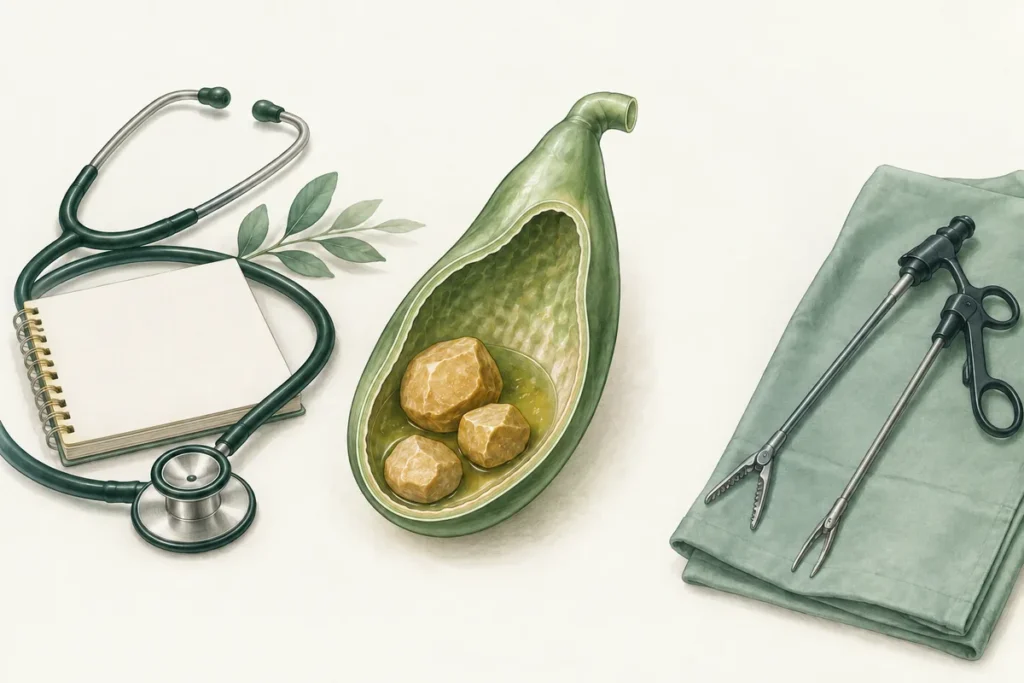
Gallstones can remain unnoticed for a long time. If there are no symptoms or complications, monitoring is often enough. When pain or complications develop, a clinician assesses the need for treatment. Stones can change in size, but growth alone does not determine risk: even a small stone can block a duct. Laparoscopic cholecystectomy is a common treatment for symptomatic disease. At the Center for Laparoscopic Surgery, you can discuss whether it is appropriate, its possible risks and what recovery may involve for you.
Why gallstones form
Stones form through a combination of changes in bile composition, gallbladder emptying and other factors. Crystals or sludge sometimes precede them. Understanding risk factors helps guide prevention and treatment. Relevant factors may include:
- long gaps between meals and very large portions;
- fasting and rapid weight loss;
- unbalanced or excessively restrictive diets;
- a sedentary lifestyle;
- excess calories and saturated fat in the usual diet; the overall eating pattern matters;
Age, inherited susceptibility and certain illnesses can also affect risk. The clinician considers them together with lifestyle because several processes usually contribute to gallstone formation. The assessment may look at the following changes:
- an imbalance in bile components that favors crystallization;
- incomplete emptying or altered gallbladder contraction;
- metabolic changes that increase cholesterol saturation of bile;
- inflammation or infection of the bile ducts in selected situations.
Risk can be associated with obesity, Crohn’s disease and certain other digestive disorders, as well as hormonal factors including some contraceptives. Hypothyroidism, chronic inflammation, parasitic infections and alcohol use need individual assessment and are not equally established direct causes of every stone type. Do not stop prescribed medicines without advice. Gallstonesare sometimes found alongside a tumour, adhesions, swollen ducts or variations in the shape of the organ. The clinician assesses each finding and whether there is a connection between them. Finding stones does not establish a cancer diagnosis, and a fold does not necessarily explain why the stones formed.
Symptoms of gallstones
Gallstones often cause no complaints for a long time and may be found incidentally, regardless of size. The following symptoms can be reasons to investigate but do not prove stones by themselves:
- a bitter taste;
- heaviness under the right ribs;
- frequent belching;
- episodes of biliary colic; altered bowel movements may reflect another condition.
When a stone enters a duct, it can interfere with bile drainage and cause pain. An attack sometimes follows a fatty or large meal, but it may occur without an obvious trigger. Any relationship with fried or spicy foods, alcohol, physical exertion or emotional strain is considered alongside the other symptoms.
Pain may spread to the right shoulder blade, shoulder or back, or be felt in the upper middle part of the abdomen. Pain spreading to the arm or neck is less typical. It may build over an hour and continue for several hours. Seek help promptly if it is severe or does not settle. Fever, sweating, jaundice or repeated vomiting may also indicate a complication and require urgent assessment.
Persistent or recurrent symptoms can include various complaints, some of which warrant investigation for another cause:
- vomiting, sometimes with bile, loss of appetite or poor tolerance of certain foods; jaundice is a warning sign;
- diarrhea or constipation; pale stools and dark urine require assessment of bile drainage;
- a white or brown tongue coating, which is not specific to gallstones;
- pain with jolting or movement and a raised temperature, even if mild;
- weakness and fatigue; joint pain is not a typical diagnostic feature of gallstone disease.
Severe or persistent pain, fever, jaundice or vomiting needs emergency assessment. Timely care helps identify complications and choose the right treatment. Delaying care may make treatment more complex; the surgeon assesses whether laparoscopy or an open approach is appropriate based on the findings.
Types of gallstones
Stones vary in composition, shape and size. Growth rates are individual. Main types are described by their predominant components.
- Cholesterol stones contain mainly cholesterol and vary in shape and size. Formation relates to bile composition and emptying, sometimes with excess body weight. Inflammation may or may not be present. They generally form in the gallbladder.
- Pigment stones contain bilirubin compounds. Some relate to increased red blood cell breakdown, including hereditary conditions, while others are associated with infection and stasis in the ducts. They can occur in the gallbladder or ducts and vary in size.
- Calcified stones contain calcium salts deposited on other components. Inflammation, microorganisms, cellular material and cholesterol crystals may contribute, but composition is often mixed rather than purely calcium.
- Mixed stones contain several components, sometimes arranged in layers: cholesterol, pigments and calcium salts. Ordinary ultrasound cannot always determine the exact composition.
The composition of a stone helps determine whether medicines might dissolve it. Calcified and pigment stones are generally unsuitable for treatment with bile acids. When considering surgery, the clinician assesses the composition and structure together with symptoms, the condition of the gallbladder and the risk of complications.
Gallstone sizes
Stone size is considered alongside symptoms and investigation results. Stones under 10 mm are sometimes called small, but they can become trapped in a duct and cause pancreatitis. A small size therefore does not mean that a stone will pass safely in the stool. Avoid trying to stimulate its passage yourself; discuss treatment options with a clinician.
Stones measuring 10-20 mm can also cause pain or block a duct. Laparoscopic gallbladder removal is usually discussed when gallstones cause symptoms. Medicines to dissolve stones or procedures to break them up are suitable only for selected patients. The clinician reviews stone composition, gallbladder function and clinical risks before proposing either approach.
Symptoms do not always reflect stone size: small stones may cause pain, while medium or large stones may remain unnoticed. Even with a stone measuring 2 cm, the decision about surgery depends on symptoms, the gallbladder wall and other factors. If a duct is blocked, the clinician also checks for complications, including damage to the wall or ducts, to decide how urgently treatment is needed and which approach is appropriate.
Complications of calculous cholecystitis
A blocked duct or inflammation can lead to complications, particularly if necessary care is delayed. Stones found by chance without symptoms or complications can often be monitored. To choose an appropriate plan, the clinician assesses the likelihood of the following problems:
- acute infectious cholangitis, sepsis, liver abscess or pancreatitis;
- gallbladder perforation and peritonitis;
- a fistula between the gallbladder and duodenum;
- rare bowel obstruction when a large stone enters the intestine.
Biliary pancreatitis affects the pancreas, while phlegmonous calculous cholecystitis affects the gallbladder. Both are inflammatory complications that can be severe and sometimes involve pus. Their later course differs; an acute episode does not necessarily lead to chronic disease in every patient.
A prolonged blockage of the bile ducts can damage the liver, making timely restoration of drainage important. Gallstones are also associated with a higher risk of gallbladder cancer, but the absolute risk remains low: most people with stones never develop this cancer. Investigations help assess any liver damage, including cirrhosis, and concerning tissue changes. The findings are considered together with symptoms when deciding whether surgery is appropriate.
Treating gallstone disease
Management may include observation, medicines in selected cases, endoscopic removal of duct stones or surgery. Assessment usually starts with examination, blood tests and ultrasound. Endoscopic ultrasound, CT, MRI and X-ray techniques are used for specific indications; oral cholecystography now has a limited role. Every patient does not need all these tests. Check their availability at the center in advance.
Ursodeoxycholic acid may be considered for selected small cholesterol stones in carefully chosen patients. A diameter under 1 cm alone is not enough to prescribe it. Treatment may take months or years, does not always work, and stones can recur. Products containing this active ingredient may be sold as:
- Ursosan;
- Ursoliv;
- Ursofalk;
- Ursodex.
Shockwave fragmentation is a separate treatment used rarely and for specific indications. Ordinary ultrasound physiotherapy does not perform this function. A specialist decides whether fragmentation is suitable; it is not routinely required whenever medicines are prescribed.
Medicines to relieve symptoms are chosen after assessing the cause of pain and any reasons a particular drug may be unsuitable. Examples to discuss with your clinician include:
- Allochol and other choleretics do not remove a stone and may be unsuitable with blocked ducts;
- No-Spa and other antispasmodics are sometimes used for symptoms but do not treat every cause of pain;
- Tempalgin, a pain-relieving medicine whose contraindications and possible side effects need to be considered before a clinician recommends its use;
- indomethacin and ibuprofen are NSAIDs that may be used for pain when appropriate, but do not replace treatment of obstruction or infection.
Surgical treatment
Stones may recur after drug dissolution because the predisposition remains. However, disease does not progress identically in everyone. For symptomatic stones, laparoscopic cholecystectomy is generally the main treatment; uncomplicated symptom-free stones are often observed.
During laparoscopy, the surgeon works through small incisions using a camera to guide the procedure. Recovery is usually quicker than after open surgery, while possible complications are still considered when choosing the approach. Cholecystolithotomy removes the stones and leaves the gallbladder in place. Because stones can recur, it is not standard first-line treatment. Discuss with a surgeon whether this option is suitable for you and available at the clinic.
Consultation at the Center for Laparoscopic Surgery
At a consultation, the clinician can explain whether monitoring, medicines, endoscopic stone removal or surgery is appropriate for you. You can discuss expected benefits, risks and dietary advice. When booking, ask about the consultation fee, included services and whether any current free-consultation offer applies.
You can enquire about an appointment through the website form or by calling +380953566412. Before your visit, ask who will see you, which diagnostic and treatment services are available, and how a stay at the clinic is arranged. If you are travelling from another region or country, agree the investigations, accommodation and other practical details in advance.
Questions and answers
They are solid formations of different composition, shape and number. They can be round or faceted, single or numerous, and range from millimeters to several centimeters. Ultrasound is the main detection method; other tests are used when indicated.
Discuss the result with a clinician. Symptom-free stones in an uncomplicated gallbladder often do not require immediate treatment. Symptoms, duct stones or complications change management. Severe persistent pain, fever, jaundice or vomiting needs urgent care.
Technically this is possible, including through cholecystolithotomy, but it is not the standard substitute for cholecystectomy for most symptomatic patients. Stones may recur. Discuss suitability, risks and long-term outcomes with a surgeon.
Laparoscopic cholecystectomy removes the gallbladder together with its stones through small incisions. Some patients go home the same or next day; others need longer. Return to work, activity and normal eating depends on health and job demands. Follow the care team’s individualized advice.
Related reading: Gallbladder ultrasound · Diet for cholecystitis · Bile duct stones.