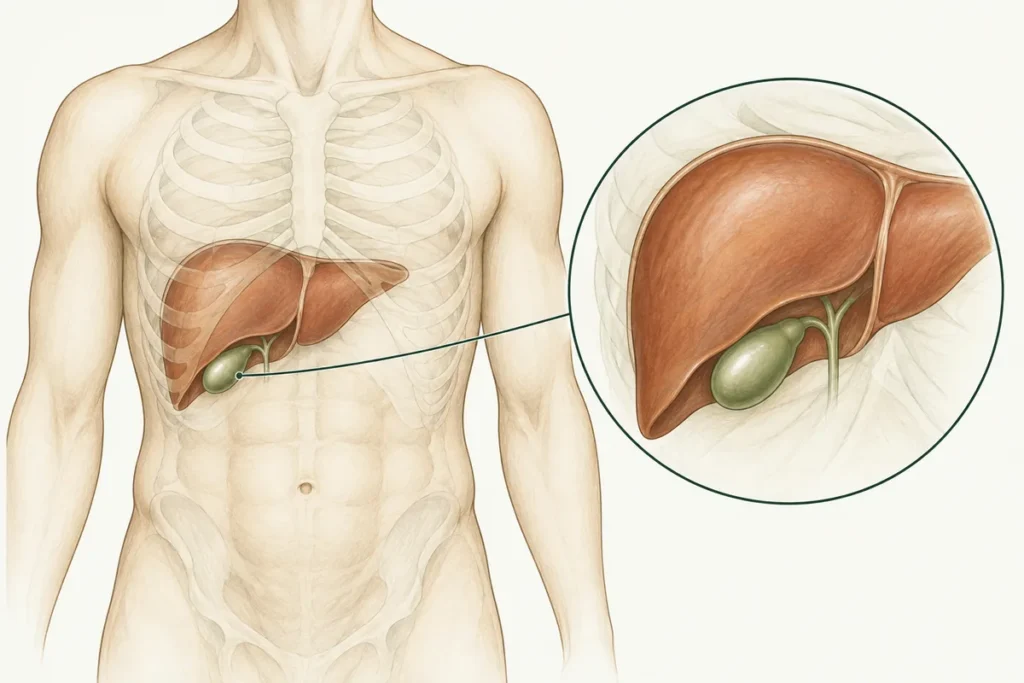
The gallbladder is a small digestive organ that works with the liver and bile ducts. It stores and concentrates bile made by the liver, then releases it into the small intestine to help digest food, particularly fats. Gallbladder conditions may cause pain and digestive problems; complications can also affect the liver and general health. Understanding its position and function can help you describe symptoms clearly to a clinician and recognise when medical attention should not be delayed.
Where is the gallbladder located?
Knowing where the gallbladder lies makes it easier to explain where you feel pain or discomfort. Other details matter too: when it started, how long it lasts and what happens alongside it. A clinician brings that history together with examination and investigation results to work out the cause, rather than relying on the location alone.
The gallbladder lies in the upper right abdomen, in a shallow depression on the underside of the liver. Its neck continues into the cystic duct, which joins the common hepatic duct to form the common bile duct. Bile travels through this system to the duodenum, the first part of the small intestine.
Which side is it on?
The gallbladder sits mainly beneath the right lobe of the liver, in a shallow depression on its underside. It is a separate organ connected to the liver by the bile ducts. Its broad end, called the fundus, may extend a little beyond the liver’s edge. A normal gallbladder cannot usually be felt through the abdominal wall. A clinician interprets any findings from palpation alongside the rest of the examination.
The gallbladder is usually on the right, close to the liver. Pain in this area can have several causes, so explain what the discomfort feels like as well as where you feel it. Its location alone cannot reliably show which organ needs treatment; assessment helps narrow down the possibilities.
Appearance and structure
The gallbladder is a small, pear-shaped sac that may have a greenish appearance because it contains bile. Bile collects inside it and is released into the bile ducts during digestion.
The gallbladder and bile ducts form the biliary system. The main parts of the gallbladder are:
- The fundus: the broad end, which may extend beyond the edge of the liver;
- The body: the portion between the fundus and the narrow end;
- The neck: the narrow portion leading into the cystic duct. Bile then passes through the common bile duct into the small intestine.
Its structure helps explain what the gallbladder looks like. Size varies with filling and individual anatomy: it may be about 10 cm long and a few centimetres wide, with a capacity of several tens of millilitres. Its wall has several layers, including an inner mucosal lining with numerous folds. The epithelial lining absorbs water and electrolytes from bile, concentrating it.
Main functions
The liver continually produces bile, while the gallbladder stores it between meals. During digestion, the gallbladder’s muscular wall contracts and sends bile into the small intestine. Storage, concentration and release are therefore connected parts of the same process. Together, they make bile available to help digest food, particularly the fats in a meal.
Each stage of this process is linked to a specific gallbladder function:
- Concentration. Bile collects in the gallbladder and becomes more concentrated as water is absorbed. It then passes into the duodenum;
- Emptying. Food entering the small intestine stimulates release of the hormone cholecystokinin. This causes the gallbladder to contract and push bile into the ducts;
- Secretion. The lining produces mucus and mucins, which contribute to the protective layer on its inner surface and to the contents of the gallbladder. This local activity of the lining complements the organ’s main work of storing and concentrating bile;
- Barrier and storage functions. The inner mucosal lining separates bile from the tissues of the gallbladder wall. Bile remains in the cavity until it is needed for digestion. Contraction of the muscular wall then helps move it through the ducts towards the small intestine;
Diseases and symptoms
Gallbladder conditions often cause pain below the right ribs. During an examination, a clinician checks for tenderness and muscle guarding and considers these findings alongside your symptoms. Feeling your own abdomen cannot reliably establish the diagnosis or show how serious the condition is, particularly when pain is persistent or worsening.
The severity and pattern of pain depend on the condition. Biliary colic occurs in episodes, although pain within an episode is often steady. Symptoms may follow a heavy or fatty meal. Any association with movement or exertion should also be discussed with a doctor.
Other symptoms may accompany the pain:
- Nausea;
- Episodes of vomiting;
- Reduced or absent appetite;
- Difficulty tolerating fatty foods;
- Digestive symptoms such as bloating, changes in bowel movements and excess gas;
- Weight loss.
Pain may start in the evening or at night and interrupt sleep. Severe or persistent pain, especially when it lasts several hours with nausea or vomiting, needs urgent assessment. Seek immediate medical help for fever, chills, jaundice, dark urine or pale stools. These warning signs matter whether this is your first episode or you have already been diagnosed with a gallbladder condition.
Cholecystitis
Cholecystitis is acute or chronic inflammation of the gallbladder. Acute inflammation most often follows blockage of the cystic duct by a stone; infection may also develop. Bile stasis can contribute. Symptoms may include pain or heaviness below the right ribs, nausea, belching and a dry mouth, but these symptoms are not specific to gallbladder disease.
Gallstone disease
Changes in bile composition and incomplete gallbladder emptying can contribute to stone formation. Metabolic and hormonal factors and some digestive conditions may also play a role. Cholesterol or pigment stones can develop in the gallbladder and sometimes block the bile ducts.
A stone blocking a duct can cause biliary colic: severe upper abdominal pain that may spread beneath the shoulder blade, to the right shoulder, back or collarbone area. Stones that do not cause obstruction often produce no symptoms at all.
Gallbladder cancer
A gallbladder tumour may develop for some time without noticeable symptoms. Later, there may be a dull or persistent ache below the right ribs, nausea, vomiting, weakness or unexplained weight loss. These changes need investigation because several other conditions can cause similar symptoms. Tell your clinician how the pain changes and whether painkillers help: this contributes to the assessment, but the response to a medicine does not establish the diagnosis on its own.
Consultation at the clinic
Gallbladder problems can substantially affect wellbeing. Persistent pain or discomfort on the right, nausea and vomiting can interfere with everyday life, particularly during an acute episode or a flare-up of a chronic condition.
During a consultation, the specialist can go through your symptoms, answer questions and explain which investigations are appropriate. You may be given referrals to help clarify the diagnosis. Before the appointment, think about when the pain started, how long it lasts and whether it follows food; these details make the discussion more useful. Ask about current booking arrangements, fees and any available free consultation on +380953566412.