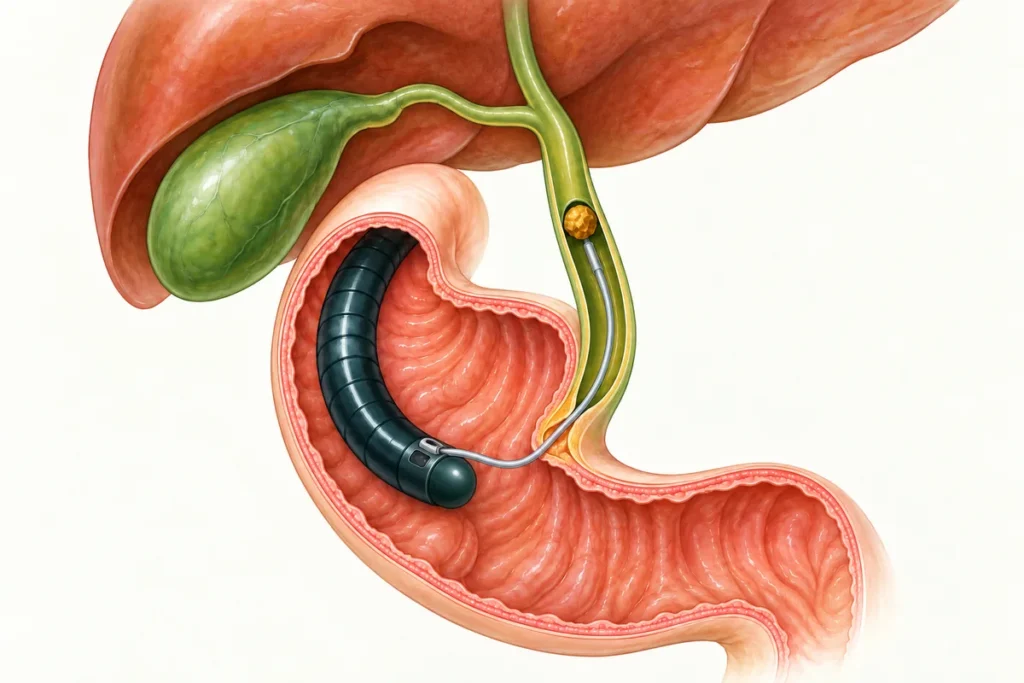
ERCP can remove stones from the common bile duct and restore bile drainage. The full name is endoscopic retrograde cholangiopancreatography. It combines a flexible endoscope passed through the mouth with X-ray guidance and small treatment instruments. Understanding why it is proposed, what it can achieve and what happens afterwards helps you prepare for an informed discussion with the treating team.
What ERCP treats
The liver produces bile, and the gallbladder stores it between meals. Bile reaches the intestine through the bile ducts. A stone that moves into the common bile duct can obstruct this flow, causing jaundice, infection or pancreatitis. Stones in this location need a different discussion from stones confined to the gallbladder, including stones found incidentally without symptoms.
For duct stones, the purpose of ERCP is usually treatment: removing an obstruction or providing drainage. It does not remove the gallbladder. The urgency depends on the findings. Infection in an obstructed duct, called cholangitis, may require urgent drainage alongside hospital treatment.
ERCP is not routine for every episode of gallstone pancreatitis. Cholangitis or evidence of continuing bile-duct obstruction changes the decision. The relationship between these conditions is explained in the article about pancreatitis and cholecystitis.
Why MRCP or endoscopic ultrasound may come first
Assessment usually starts with symptoms, examination, blood tests and abdominal ultrasound. Ultrasound can identify gallbladder stones and duct enlargement, but it may not show every stone inside the common bile duct. Abnormal liver tests or a widened duct can therefore prompt further investigation.
MRCP is a specialised MRI examination that produces images of the bile and pancreatic ducts. Endoscopic ultrasound, or EUS, uses an ultrasound probe on an endoscope positioned in the digestive tract. EUS is an endoscopic procedure, whereas MRCP does not require an endoscope. These tests can clarify whether a stone is present before an intervention is planned.
When the question is purely diagnostic, the team usually considers lower-risk imaging before ERCP. If a treatable blockage is already established or urgent drainage is needed, another diagnostic test may add little. Ask what uncertainty remains and how the result would change treatment.
ERCP and surgical duct clearance
During ERCP, the instruments reach the duct through its opening into the intestine. During laparoscopic bile-duct stone removal, the surgeon approaches the duct through small abdominal incisions. Surgical clearance can sometimes be combined with gallbladder removal in one operation; ERCP and gallbladder surgery may form separate stages of a treatment plan.
The choice depends on the number and position of stones, duct anatomy, previous operations, infection, general health and the expertise available. Neither approach is best for every patient. A difficult stone or altered anatomy may require more than one procedure or a different technique. Before consenting, ask what the team plans to do if the duct cannot be cleared at the first attempt.
Preparation: obtain an individual written plan
Bring available scan reports, previous procedure records and a complete medicine list, including non-prescription products and supplements. Tell the team about allergies, earlier problems with sedation or anaesthesia, heart or lung disease, sleep apnoea, diabetes and any previous stomach or bowel surgery. Mention pregnancy or the possibility of pregnancy because ERCP uses X-rays.
- Ask specifically about anticoagulants and antiplatelet medicines. Stopping them can also carry risks, so never change them on your own.
- Obtain instructions for insulin and other diabetes or weight-loss medicines, including what to do while fasting.
- Confirm when to stop solid food and which drinks, if any, are allowed. Follow the instructions from the team performing the procedure.
- Arrange an adult escort and any support needed at home after sedation or anaesthesia.
If instructions are unclear, or you have eaten, drunk or taken a medicine differently from the agreed plan, tell the unit before the procedure. Emergency ERCP has its own preparation pathway, directed by the hospital team.
What happens during the procedure
The team checks the reason for treatment, reviews your medical history and discusses consent. A cannula in a vein allows medicines and fluids to be given. Sedation or general anaesthesia is selected according to the procedure and your health, with monitoring throughout.
The endoscope passes through the mouth, stomach and into the duodenum, the first part of the small intestine. A thin catheter enters the duct opening. Contrast and X-ray images help the endoscopist assess the duct and guide treatment. A small cut at the opening, called a sphincterotomy, or balloon widening may be needed to allow stone extraction.
Stones can be removed with a balloon or basket. Some difficult stones require fragmentation or another specialist approach. The aim is safe clearance and adequate drainage; it is sometimes safer to stop, place a temporary stent and arrange further treatment.
Benefits and risks to discuss
The intended benefit is relief of obstruction and treatment of its consequences. ERCP also has important risks, even when there are no abdominal incisions:
- Pancreatitis, which can require hospital treatment and is occasionally severe.
- Bleeding, particularly after a cut at the duct opening.
- Infection, including when bile drainage remains incomplete.
- Perforation, meaning a tear or hole in the intestine or duct.
- Breathing, heart or other reactions related to sedation or anaesthesia.
Complications may require additional endoscopic treatment, a longer hospital stay or occasionally surgery, and can rarely be life-threatening. Your risk depends on your health and the treatment needed. The team chooses preventive measures where appropriate. Ask about your individual risk rather than relying on another patient’s experience or a general success figure.
A temporary stent needs a follow-up plan
A biliary stent is a small tube that helps bile drain. If a stone cannot be completely removed, a temporary stent can relieve the obstruction while further endoscopic or surgical treatment is arranged. Feeling better after drainage does not establish that the stone has gone.
Before leaving, obtain a record of whether a stent was inserted, what type it is, who is responsible for follow-up and when reassessment, removal or replacement is planned. Temporary biliary stents can block or move. Missing follow-up can lead to infection or recurrent obstruction even after a symptom-free period.
If no appointment or contact plan has been provided, contact the treating unit rather than waiting for symptoms. If a separate pancreatic-duct stent was used to reduce pancreatitis risk, clarify its follow-up too. The two stents serve different purposes.
Recovery and symptoms that need urgent help
After ERCP, you are observed while the medicines wear off and the team checks your condition. Some people go home the same day; others need inpatient care because of the original illness, the procedure or a complication. Mild bloating or a sore throat can occur, but pain that is severe or increasing needs assessment.
Follow the discharge instructions about eating, drinking, regular medicines, driving, alcohol, work and supervision at home. Sedation can affect judgment even when you feel awake. Keep the procedure report and the unit’s contact details accessible.
Seek urgent medical assessment for:
- Severe or increasing abdominal or chest pain, or repeated vomiting.
- Fever or chills, especially with jaundice or abdominal pain.
- Vomiting blood, black tar-like stools or other significant bleeding.
- Difficulty breathing, fainting, or worsening difficulty swallowing.
Use emergency services if you are seriously unwell. Do not wait for an online reply or the planned follow-up visit. Tell the clinician when ERCP was performed and whether a stent was placed.
Why gallbladder surgery may still be discussed
If the gallbladder remains a source of stones, clearing the duct does not remove that source. Laparoscopic cholecystectomy may therefore be recommended to reduce further gallstone-related problems. The timing depends on infection, pancreatitis severity, fitness for surgery and how the duct was treated.
When an operation is unsuitable, the team discusses an individual alternative and its limitations. If surgery is planned, recovery after gallbladder removal is a separate stage with its own instructions. Before discharge, make sure you understand whether duct treatment is complete, whether a stent remains and who will arrange the next appointment.
Frequently asked questions
Will ERCP leave scars on my abdomen?
ERCP itself uses access through the mouth and does not require abdominal skin incisions. Internal treatment may still involve a cut at the duct opening and has risks. A separate gallbladder operation uses a different approach.
Can I have ERCP after my gallbladder has been removed?
Yes, if there is an appropriate indication. Stones can remain in, or later form within, the bile ducts after gallbladder removal. Symptoms and imaging guide the assessment; a previous operation alone is not a reason for ERCP.
Does a small stone always pass by itself?
Some stones pass into the intestine, but this cannot be safely predicted from size alone. Migration can cause pancreatitis or obstruction. Do not postpone the agreed assessment because pain has eased or a stone was described as small.
Is a second ERCP a sign that the first failed?
Not necessarily. Treatment can be deliberately staged when stones are difficult to remove or drainage is the immediate priority. Ask what was achieved, what remains and whether another endoscopic procedure or surgery is planned.
Can ERCP be performed during pregnancy?
It may be considered for a clear therapeutic indication, particularly symptomatic duct stones or complications. Specialist teams weigh maternal and fetal risks, coordinate obstetric care and minimise radiation exposure. Pregnancy requires an individual plan rather than automatic postponement.
Can I return to work the next day?
There is no single timetable. The effects of sedation, the treatment performed, the original illness and the demands of your job all matter. Follow the discharge advice, particularly for driving, machinery and safety-critical work.
Sources
- NIDDK: ERCP
- NICE CG188: Gallstone disease
- ASGE: Understanding ERCP
- ACG: ERCP – A Patient’s Guide
- ACG: Acute Pancreatitis guideline highlights (2024)
- SAGES: Laparoscopy during pregnancy guideline (2024)
Sources checked: 13 October 2026.